2025
Upcoming
Exhibition, CCA, Main Galleries, 20 November 2025 to 5 April 2026
Location: Canadian Centre for Architecture, 1920 Baile, Montreal, QC H3H 2S6
For more information, consult the CCA: https://www.cca.qc.ca/en/events/96996/how-modern
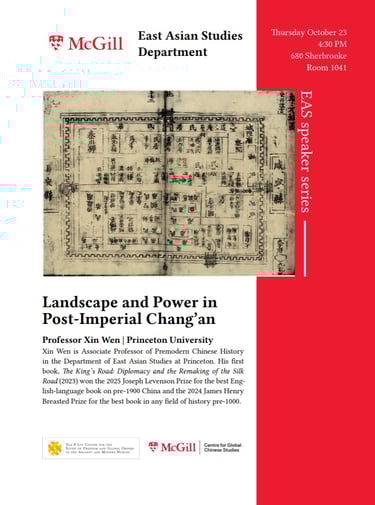
Landscape and Power in Post-Imperial Chang’an
EAST ASIAN STUDIES DEPARTMENT
Location: 680 Sherbrooke Room 1041
Date: Thursday October 23rd, 2025, 4:30 pm
Registration: Free
Xin Wen (Princeton University)
Abstract: Chang’an, the capital of the Tang (618–907) dynasty, had a walled area of 84 square kilometers and a population of one million, making it the largest city in the medieval world. After the fall of the Tang, a new Chang’an emerged within the old city. This smaller Chang’an, about 6 percent in landmass compared to the old city, continued to function as a regional center to this day. This lecture explores the landscape of this smaller city in the period from tenth through the fourteenth century. Although urban historians of China paid little attention to Chang’an after it lost the status of the imperial capital, I show that the rich material remains from Chang’an, perhaps the best documented of any Chinese city in this period, allow a detailed account of its urban morphology. By telling how new monasteries and residential quarters were built while old palaces were abandoned and old monuments repurposed, I show that the power that drove the landscape changes in post-imperial Chang’an was not primarily the commercial one. Instead, a negotiation between itinerant imperial representatives and local magnates determined the shape of the city. This case study of Chang’an helps us recognize a southern bias in the study of the city in Middle Period China, and compels us to rethink the role of the “medieval commercial revolution” in China’s urban history.
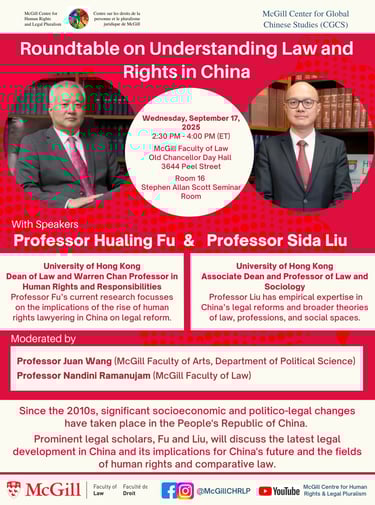
Roundtable on Understanding Law and Rights in China
THE CENTER FOR GLOBAL CHINESE STUDIES AT MCGILL
Location: 3644 Peel Street, Stephen Allan Scott Seminar Room, Room 16
Date: Wednesday September 17th, 2025, 2:30 pm -4:00 pm
Registration: Free
Hualing Fu & Sidu Liu (University of Hong Kong)
Abstract: Since the 2010s, significant socioeconomic and politico-legal changes have taken place in the People's Republic of China. Prominent legal scholars, Fu and Liu, will discuss the latest legal development in China and its implications for China's future and the fields of human rights and comparative law.
Speaker bio - Fu:
Dean of Law and Warren Chan Professor in Human Rights and Responsibilities. Professor Fu's current research focusses on the implications of the rise of human rights lawyering in China on legal reform.
Speaker bio - Liu:
Associate Dean and Professor of Law and Sociology. Professor Liu has empirical expertise China's legal reforms and broader theories of law, professions, and social spaces.
Paying for Promotion: Re-imagine Political Selection in an Authoritarian Regime
THE CENTER FOR GLOBAL CHINESE STUDIES AT MCGILL
Location: 855 Sherbrooke St W, Leacock Building, room 429
Date: Monday September 15th, 2025, 11:30 am -1:00 pm
Registration: Free
Jiangnan Zhu (University of Hong Kong)
Abstract: The purchase of government positions has deep historical roots across cultures. In pre-modern states, including colonial European empires, it was often an accepted part of the governing structure. Today, the practice of buying and selling government offices (BSO) is considered a serious form of corruption, yet it remains poorly studied and understood. In BSO, leaders take bribes from subordinates to influence recruitment, appointment, and promotion decisions, significantly impacting political selection and governance quality. In this project, I employ a dual perspective—corruption and elite mobility—to analyze the distribution of BSO across the Chinese administrative matrix, as well as the various forms and implications of BSO. I categorize BSO into four types—primitive bribery, evolved bribery, office-selling syndicates, and oligarchical powerbases, each varying in organizational complexity and relational dynamics. Using two novel, self-compiled datasets on BSO cases, I propose a tripartite framework of performance, patronage, and purchase to reimagine political selection in China, challenging the prevailing competence-loyalty dichotomy in authoritarian regimes. The tripartite framework highlights the coexistence of multiple governance models: a meritocratic state prioritizing competence, a clientelist state emphasizing loyalty, and an investment state bound by money.
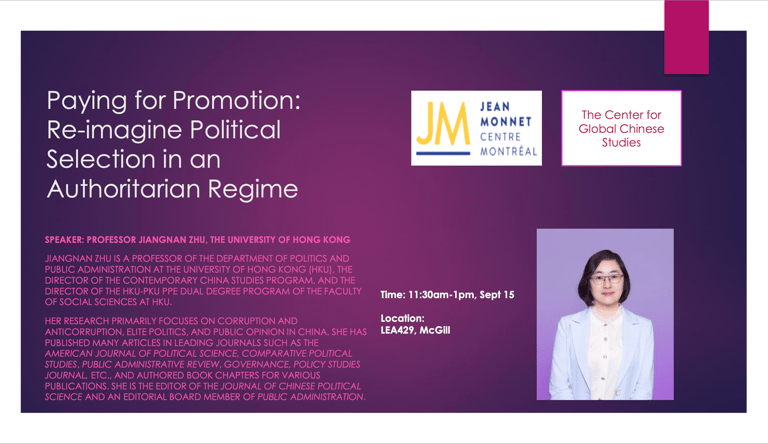
Speaker bio: Jiangnan Zhu is a professor of the department of politics and public administration at the University of Hong Kong (HKU), the director of the Contemporary China Studies Program, and the director of the HKU-PKU PPE Dual Degree Program of the faculty of social sciences at HKU. Her research primarily focuses on corruption and anticorruption, elite politics, and public opinion in China. She has published many articles in leading journals such as the American Journal of Political Science, Comparative Political Studies, Public Administrative Review, Governance, Policy Studies Journal, etc., and authored book chapters for various publications. She is the editor of the Journal of Chinese Political Science and an editorial board member of Public Administration.
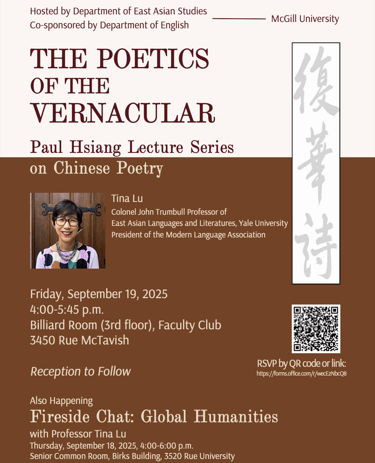
The Poetics of the Vernacular
DEPARTMENT OF EAST ASIAN STUDIES & DEPARTMENT OF ENGLISH
Location: 3450 Rue McTavish, Billiard Room (3rd floor), Faculty Club
Date: Friday September 19th, 2025, 4:00-5:45 pm
Registration: Free https://forms.office.com/r/wecEzNbcQ8
Tina Lu (Yale University)
Abstract: Professor Tina Lu, Colonel John Trumbull Professor of East Asian Languages and Literature at Yale University, and President of the Modern Languages Association, will visit McGill University to deliver the Paul Hsiang Lecture on Chinese Poetry, entitled "The Poetics of the Vernacular". The lecture will be followed by a reception.
Fireside Chat: Global Humanities
DEPARTMENT OF EAST ASIAN STUDIES & DEPARTMENT OF ENGLISH
Location: 3520 Rue University, Birks Building, Senior Common Room
Date: Thursday September 18th, 2025, 4:00-6:00 pm
Registration: Not Required
Tina Lu (Yale University)
Abstract: Professor Tina Lu, Colonel John Trumbull Professor of East Asian Languages and Literature at Yale University, and President of the Modern Languages Association, will visit McGill University to discuss the pressing challenges confronting the humanities in the increasingly complex global landscape. Professor Lu will further reflect on how humanistic inquiry can foster meaningful and positive changes.
Past
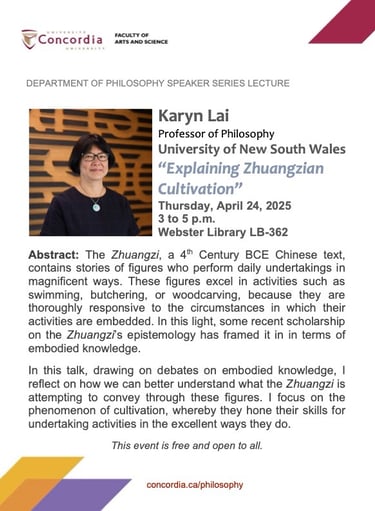
Explaining Zhuangzian Cultivation
Location: Webster Library LB-362, Pavillion J.W. McConnell Bldg, 1400 Maisonneuve Blvd W, Montreal, Quebec H3G 1M8
Date: Thursday, April 24th, 2025, 3:00-5:00 pm
Registration: Not Required
Karyn Lai (University of New South Wales)
Abstract: The Zhuangzi, a 4th Century BCE Chinese text,contains stories of figures who perform daily undertakings inmagnificent ways. These figures excel in activities such asswimming, butchering, or woodcarving, because they are thoroughly responsive to the circumstances in which their activities are embedded. In this light, some recent scholarship on the Zhuangzi’s epistemology has framed it in in terms of embodied knowledge.
In this talk, drawing on debates on embodied knowledge, I reflect on how we can better understand what the Zhuangzi is attempting to convey through these figures. I focus on the phenomenon of cultivation, whereby they hone their skills for undertaking activities in the excellent ways they do.
DEPARTMENT OF PHILOSOPHY SPEAKER SERIES LECTURE
Bridging Trade Opportunities: Growing and Diversifying Quebec’s Exports through China International Import Expo (CIIE)
Location: Fasken, 800 Rue du Square-Victoria Suite 3500 Montréal, QC H3C 0B4
Date: Wednesday, April 16th, 2025, 3:30 - 6:30 pm
Registration: Free https://www.eventbrite.ca/e/bridging-trade-opportunities-tickets-1313146168539?aff=oddtdtcreator
Abstract: As global trade landscapes shift due to geopolitical tensions and evolving tariff policies, Canadian and Quebec exporters face increasing pressure to diversify their markets. China remains a vital economic partner and a key destination for high-quality Canadian products, from agri-food and consumer goods to technology and advanced manufacturing. The China International Import Expo (CIIE) offers an unparalleled opportunity for Quebec businesses to access this market, connect with buyers, and forge lasting trade partnerships. Join us on April 16 in Montreal to hear Mr. DAI Yuming, Consul General of the People’s Republic of China in Montreal, share insights on trade between Canada and China. Dr. DENG Jun, President and CEO of Bank of China (Canada), will then discuss the upcoming CIIE in Shanghai, setting the stage for an engaging panel discussion on winning strategies for Quebec businesses at CIIE. A panel discussion on winning strategies for Quebec businesses in the China market will feature Charles Lavoie, Vice President of Marketing, WPIC Marketing + Technologies; Stéphane Fallecker, Director of Exports – Asia-Pacific and Middle East Markets, Investissement Québec International; and Lory Wang, President, Arctica Food. This event will provide practical insights, success stories, and strategic guidance to help Quebec companies better understand the latest trends in the Chinese consumer market, maximize their participation in CIIE, and expand their presence in China.
For more information: https://ccbc.com/event/bridging-trade-opportunities-growing-and-diversifying-quebecs-exports-through-china-international-import-expo-ciie/
CANADA CHINESE BUSINESS COUNCIL (CCBC)
China in 2025: Economic Shifts, Political Strategy, and What It Means for Canada-China Business Relations
Location: Borden Ladner Gervais LLP 1000 De La Gauchetière Street West, Suite 900, Montreal, Quebec, H3B 5H4
Date: Wednesday, March 26th, 2025, 4:30-7:00 pm
Registration:
CCBC Members: Free; Non-Members: $100 + tax
Abstract: Join us for an thought-provoking discussion on China’s economic and political outlook for 2025 and its impact on Canada-China business relations. As global dynamics continue to evolve, understanding China’s changing economic landscape and political trajectory is essential for businesses and policymakers navigating the shifting Canada-China relationship. Moderated by Bijan Ahmadi, CCBC Executive Director and COO, with welcome remarks from Miles Pittman, Partner at Borden Ladner Gervais LLP (BLG) and CCBC Board Director, this panel discussion features top experts: Graham Shantz, President, CCBC; Chucheng FENG, Founding Partner, Hutong Research; and Ari Van Assche, Ph.D., Professor, Department of International Business, Co-Director of the International Institute for Economic Diplomacy, HEC Montréal, and Editor-in-Chief, Journal of International Business Policy. This exclusive session will examine Beijing’s strategic approach to Trump administration and its long-term economic and political direction. As China finalizes its new five-year plan, our panelists will provide critical insights into the country’s evolving policies, key geopolitical shifts, and their direct impact on Canadian businesses, trade relations, and investment opportunities in the year ahead.
For more information: https://ccbc.com/event/china-in-2025-economic-shifts-political-strategy-canada-china-business-relations/
CANADA CHINESE BUSINESS COUNCIL (CCBC)
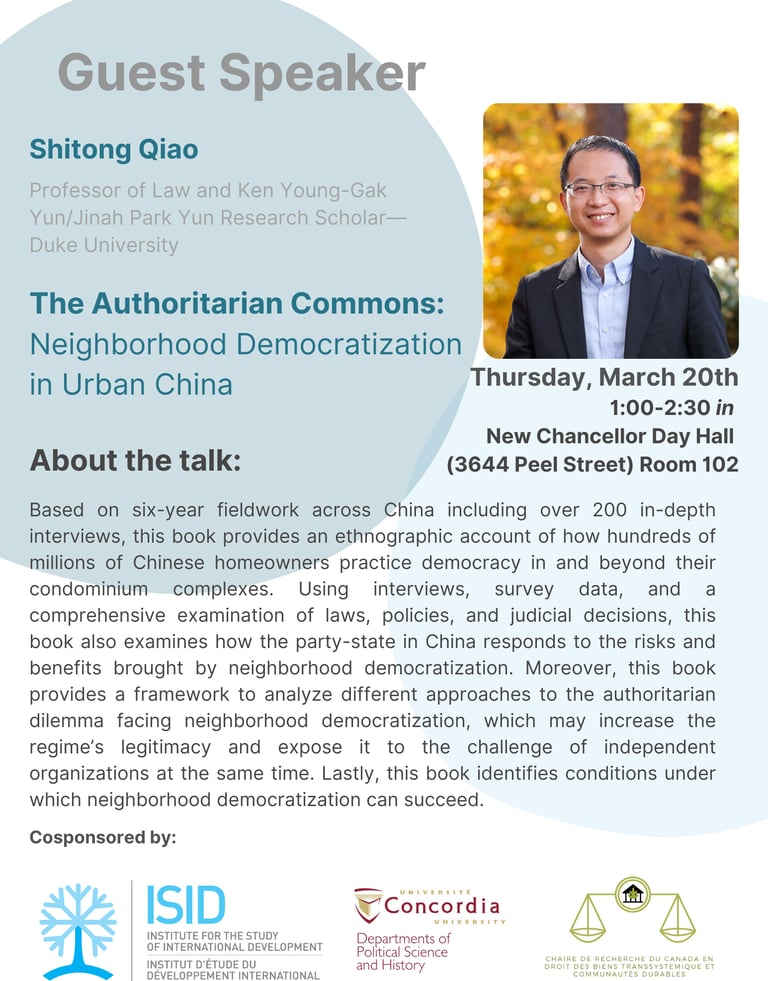
The Authoritarian Commons: Neighborhood Democratization in Urban China
Location: New Chancellor Day Hall Room 102, 3644 Peel Street, McGill University
Date: Thursday, March 20th, 2025, 1:00-2:30 pm
Registration: Not Required
Shitong Qiao (Duke University)
Abstract: Based on six-year fieldwork across China including over 200 in-depth interviews, this book provides an ethnographic account of how hundreds of millions of Chinese homeowners practice democracy in and beyond their condominium complexes. Using interviews, survey data, and a comprehensive examination of laws, policies, and judicial decisions, this book also examines how the party-state in China responds to the risks and benefits brought by neighborhood democratization. Moreover, this book provides a framework to analyze different approaches to the authoritarian dilemma facing neighborhood democratization, which may increase the regime's legitimacy and expose it to the challenge of independent organizations at the same time. Lastly, this book identifies conditions under which neighborhood democratization can succeed.
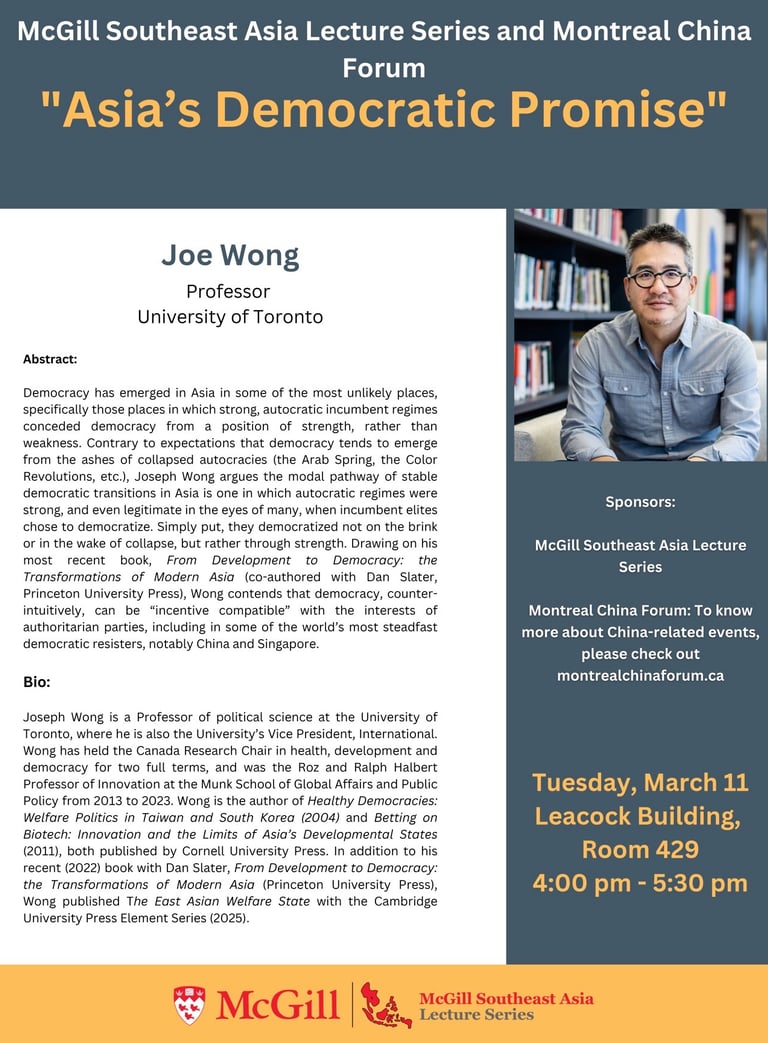
Asia's Democratic Promise
Location: Leacock Building, Room 429, 855 Sherbrooke St W
Date: Tuesday, March 11th, 2025, 4:00-5:30 pm
Registration: Not Required
Joe Wong (University of Toronto)
Abstract: Democracy has emerged in Asia in some of the most unlikely places, specifically those places in which strong, autocratic incumbent regimes conceded democracy from a position of strength, rather than weakness. Contrary to expectations that democracy tends to emerge from the ashes of collapsed autocracies (the Arab Spring, the Color Revolutions, etc.), Joseph Wong argues the modal pathway of stable democratic transitions in Asia is one in which autocratic regimes were strong, and even legitimate in the eyes of many, when incumbent elites chose to democratize. Simply put, they democratized not on the brink or in the wake of collapse, but rather through strength. Drawing on his most recent book, From Development to Democracy: The Transformations of Modern Asia (co-authored with Dan Slater, Princeton University Press), Wong contends that democracy, counterintuitively, can be “incentive compatible” with the interests of authoritarian parties, including in some of the world’s most steadfast democratic resisters, notably China and Singapore.
McGILL SOUTHEAST ASIA LECTURES SERIES AND MONTREAL CHINA FORUM
Living with Digital Surveillance in China. Citizens Narratives on Technology, Privacy and Governance
Location: Armstrong 155A, 3420 McTavish Street, McGill University
Date: Friday, February 14th, 2025, 10:30-12:00 pm
Registration: Not Required
Ariane Ollier-Malaterre (UQAM)
Abstract: Digital surveillance is a daily and all-encompassing reality of life in China. This book explores how Chinese citizens make sense of digital surveillance and live with it. It investigates their imaginaries about surveillance and privacy from within the Chinese socio-political system. Based on in-depth qualitative research interviews, detailed diary notes, and extensive documentation, Ariane Ollier-Malaterre strives to ‘de-Westernize’ the internet and surveillance literature. She shows how the research participants weave a cohesive system of anguishing narratives on China’s moral shortcomings and redeeming narratives on the government and technology as civilizing forces. Although many participants cast digital surveillance as indispensable in China, their misgivings, objections, and the mental tactics they employ to dissociate themselves from surveillance convey the mental and emotional weight associated with such surveillance exposure. The author also reflects on fieldwork in China as a foreign researcher. She discusses the choices she has made to reduce her Eurocentric biases and what she has learned about interviewing in a context of political censorship.
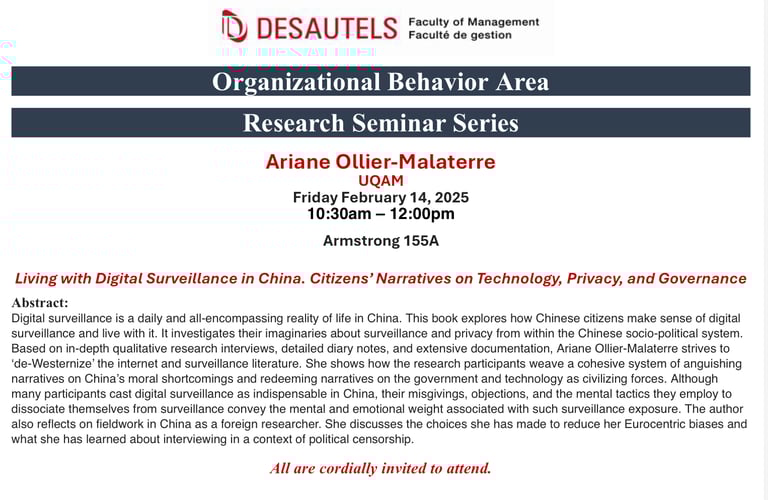
ORGANIZATIONAL BEHAVIOR AREA RESEARCH SEMINAR SERIES
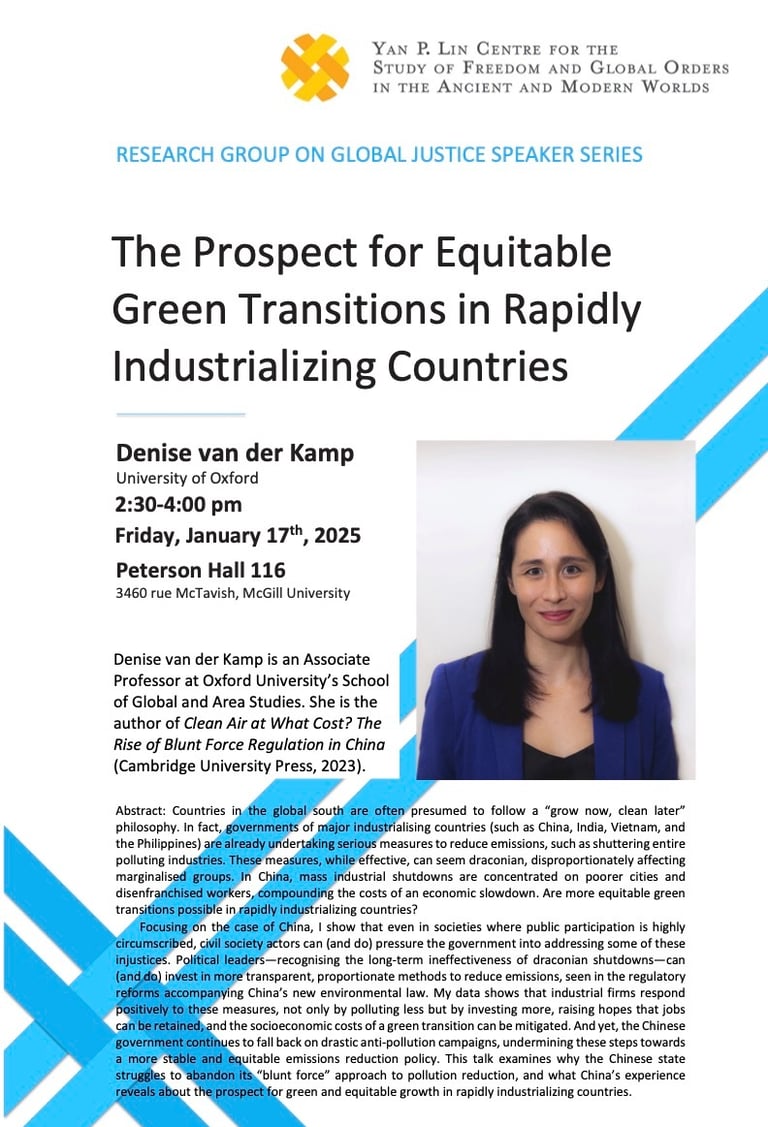
The Prospect for Equitable Green Transitions in Rapidly Industralizing Countries
RESEARCH GROUP ON GLOBAL JUSTICE SPEAKER SERIES
Location: Peterson Hall 116, 3460 McTavish Street, McGill University
Date: Friday, January 17th, 2025, 2:30-4:00 pm
Registration: Not Required
Denise van der Kamp (University of Oxford)
Abstract: Countries in the global south are often presumed to follow a “grow now, clean later” philosophy. In fact, governments of major industrialising countries (such as China, India, Vietnam, and the Philippines) are already undertaking serious measures to reduce emissions, such as shuttering entire polluting industries. These measures, while effective, can seem draconian, disproportionately affectingmarginalised groups. In China, mass industrial shutdowns are concentrated on poorer cities anddisenfranchised workers, compounding the costs of an economic slowdown. Are more equitable green transitions possible in rapidly industrializing countries?
Focusing on the case of China, I show that even in societies where public participation is highly circumscribed, civil society actors can (and do) pressure the government into addressing some of these injustices. Political leaders—recognising the long-term ineffectiveness of draconian shutdowns—can (and do) invest in more transparent, proportionate methods to reduce emissions, seen in the regulatory reforms accompanying China’s new environmental law. My data shows that industrial firms respond positively to these measures, not only by polluting less but by investing more, raising hopes that jobs can be retained, and the socioeconomic costs of a green transition can be mitigated. And yet, the Chinese government continues to fall back on drastic anti-pollution campaigns, undermining these steps towards a more stable and equitable emissions reduction policy. This talk examines why the Chinese state struggles to abandon its “blunt force” approach to pollution reduction, and what China’s experience reveals about the prospect for green and equitable growth in rapidly industrializing countries.